Caregiving · April 16, 2026 · 10 min read
Amma Is in Lucknow. I Am in Bengaluru. And I Have No Idea If She Took Her Tablets This Morning.
India's urban migration has created millions of distance caregivers managing elderly parents' chronic medicines from another city. The Sunday phone call cannot tell you what you need to know.
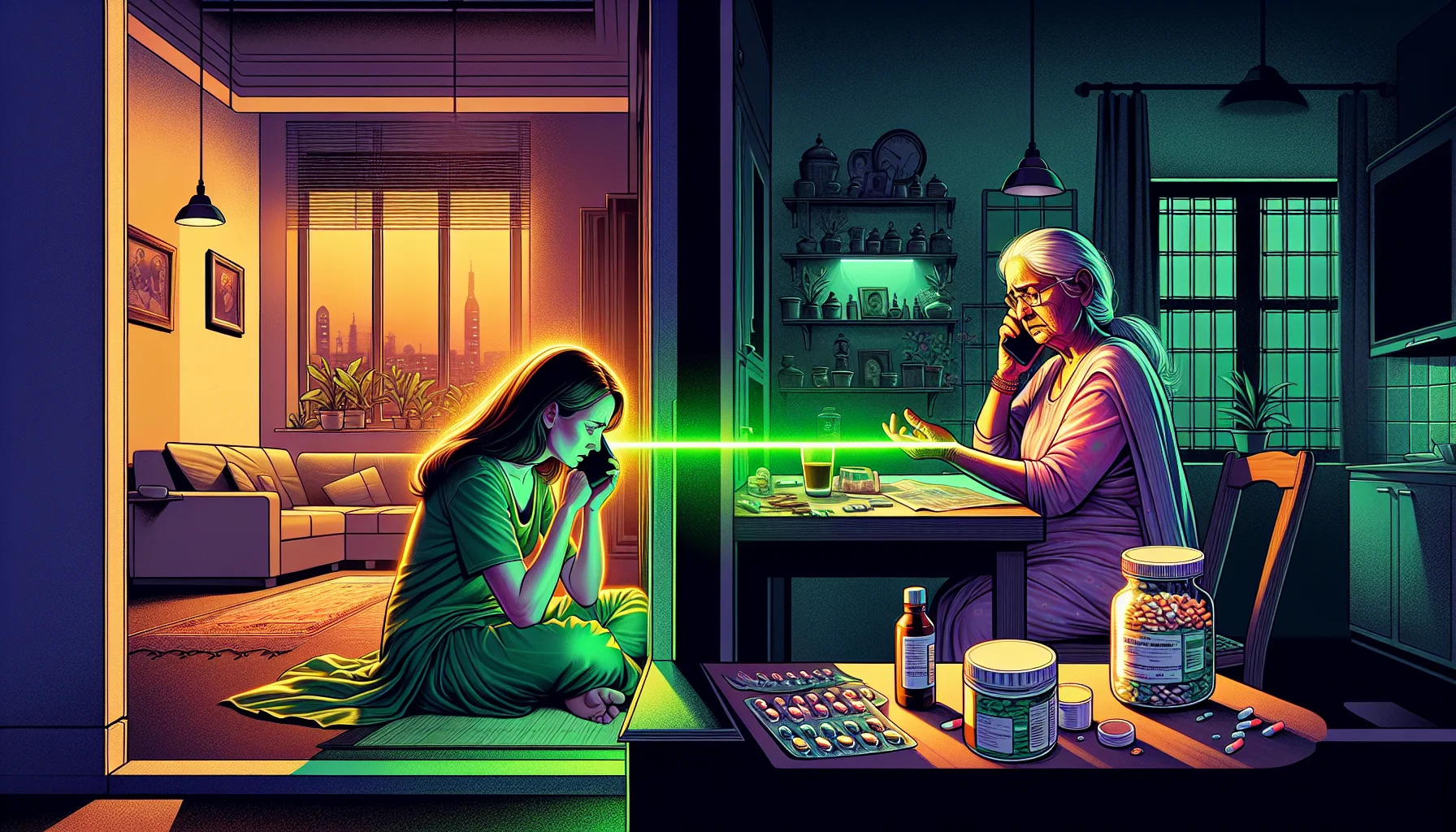
India's urban migration has quietly created a generation of distance caregivers — adult children managing elderly parents' medicines from hundreds of kilometres away, on trust and weekly phone calls. Here is what the data says about how well that is working.
- Parents living without children nearby increased from 22% in 2011 to 27% in 2017–18 — a trend that has accelerated with post-pandemic urban migration
- 70% of Indian senior citizens have at least one chronic illness, most requiring daily medicines
- Only 23.7% of urban elderly with chronic diseases show meaningful adherence to their treatment — the majority are missing doses regularly
- India faces a deficit of 4.3 million professional caregivers, leaving families to improvise with phone calls and neighbours
- 50% of Indian elderly living alone report depression — a condition that directly reduces motivation to take medicines consistently
Every Sunday evening, I call amma. The first question is always the same: "Did you take your tablets today?" She says yes. She says it the same way she used to say she had eaten when she had not — a little too quickly, a little too cheerfully, hoping I won't ask a follow-up.
Sometimes I do ask. "Both of them? The BP one and the thyroid one?" She says yes. I believe her because I want to believe her, because the alternative — that she is sitting alone in our Lucknow house, forgetting her medicines and not wanting to worry me — is something I cannot fix from Bengaluru on a Sunday evening.
This is the reality for millions of Indian families right now. Not neglect. Not indifference. Just distance, and the particular helplessness of caring deeply about someone you cannot see.
What the Sunday Phone Call Can and Cannot Tell You
The Sunday call has become the infrastructure of distance caregiving in India. It is the weekly status report, the reassurance ritual, the substitute for being there. And it fails at the one thing that matters most: actually knowing whether the medicines were taken.
A phone call tells you how your parent sounds. It tells you their mood, whether they ate, whether the neighbour visited. What it cannot tell you is whether the small white tablet — the one the cardiologist prescribed and which needs to be taken every morning without fail — was actually swallowed today, or yesterday, or the day before.
Elderly parents, especially those who have spent a lifetime not wanting to burden their children, are skilled at reassurance. They say "haan, le li" — yes, I took it — with genuine confidence, sometimes because they did take it, sometimes because they believe they took it, and sometimes because they do not want you to worry. Distinguishing between these three is impossible over the phone.
My mother has hypertension and hypothyroidism. She lives alone in Coimbatore since my father passed. I call every morning before work to remind her. For two years, I thought this was working. Then she had a small stroke. When I went down, I found that the thyroid medicine she said she was taking regularly had not been refilled in six weeks. She genuinely did not remember that she had run out.
— IT professional, Hyderabad (shared in a long-distance caregiving forum)
The phone call is not nothing. But it is not enough. And for millions of Indian families stretched across cities, it is all they have.
The Scale of India's Distance Caregiving Crisis
India's urban migration story is usually told as an economic success: young people moving to cities for better opportunities, building careers, sending money home. The untold side of that story is the parents left behind — in Lucknow, in Madurai, in Ranchi, in Nagpur — managing their chronic conditions with declining support and increasing isolation.
The Longitudinal Ageing Study in India (LASI) found that two in every three senior citizens have at least one chronic disease, with hypertension and diabetes accounting for 68% of all chronic conditions. These are not diseases that resolve. They are conditions that require daily management, consistent medicines, and regular monitoring — for years, sometimes decades.
The mental health dimension makes it worse. Research published in BMC Psychiatry found that elderly individuals living without their children are significantly more vulnerable to depression. And depression, in turn, directly undermines medicine adherence — when you do not feel that the future matters much, the morning tablet can easily get forgotten.
The changing traditional family structure due to out-migration of children is challenging for the elderly in terms of accessibility to health and caregiving, as older adults in these circumstances suffer from multi-morbidity conditions with limited support.
— PMC Research, Physical and mental health among older parents: Does offspring migration matter? (2023)
This is not a niche problem affecting a small number of families. It is the lived reality of an entire generation of Indian adults who moved to cities for their careers and now carry the silent weight of not knowing what is happening at home.
"She Said She Took It" — The Gap Between Reassurance and Reality
Medication adherence research has a concept called the "intention-behaviour gap" — the distance between what a patient intends to do and what they actually do. For elderly patients managing multiple chronic medicines alone, this gap is substantial.
Only 23.7% of urban elderly with chronic conditions in India are consistently adherent to their treatment — a figure from a descriptive cross-sectional study published in the Biomedical and Pharmacology Journal. The remaining 76% are missing doses, taking medicines at the wrong time, stopping when they feel better, or running out and not refilling promptly.
For a parent living alone, the reasons layer on top of each other in ways that are hard to untangle from a phone call. Forgetfulness is the most obvious, but it is far from the only one. There is the episodic disease belief — "I feel fine, so I must not need it today." There is the practical barrier of running out of a strip and finding it difficult to get to the chemist alone. There is the emotional barrier of not wanting to admit to a worried child that things have slipped.
| Reason for missed dose | What parent tells child | What is actually happening |
|---|---|---|
| Forgetfulness | "Yes, I took it" (genuinely believes this) | Dose was skipped, memory of taking it was fabricated unconsciously |
| Strip ran out | "It's all fine, don't worry" | Has been without medicine for 3–5 days, waiting for someone to get the refill |
| Felt well, decided to skip | "Doctor said I could reduce it" | Self-adjusted dose based on feeling, no medical guidance |
| Side effect discomfort | "I took a small break, just for today" | Has been skipping for days due to nausea or dizziness, hasn't told anyone |
| Confusion about which tablet | "Yes yes, I take everything" | Taking one of three correctly; confusing the other two |
The Sunday phone call establishes emotional connection. It does not establish medication adherence. For elderly parents managing chronic conditions alone, these two things are almost entirely separate — and only one of them keeps them out of the hospital.
The Workarounds Families Try — And Why They Break Down
Indian families are resourceful. When the system does not provide what is needed, they improvise. Distance caregivers have developed an entire informal infrastructure for managing a parent's medicines from another city — and every part of it has a predictable failure mode.
| Workaround | What families do | Where it breaks |
|---|---|---|
| Daily reminder calls | Call every morning at medicine time | Parent doesn't pick up, or says "haan haan" and doesn't take it |
| Neighbour supervision | Ask a trusted neighbour to check in | Neighbour has their own life; supervision becomes sporadic within weeks |
| Domestic help | Ask the bai to give medicines at the right time | Bai takes a day off; no backup; no one tracks whether doses were actually given |
| Pill organiser by courier | Pre-fill a weekly box, send it monthly | Doesn't tell you if the box was used; parent may stop using it |
| Online pharmacy auto-delivery | Set up PharmEasy or Netmeds subscription | Delivery delays, brand substitutions, prescription expiry issues |
| Part-time caregiver | Hire someone for 2 hours a day | Expensive, inconsistent; caregivers leave; no continuity of care |
I tried everything. Morning alarm on my father's phone — he silences it. Asking our neighbour aunty — she does her best, but she's 70 herself. I even flew down for a week to set up a system. It worked for about three weeks after I left. Then things slowly went back to how they were. There's no system that works when I'm not there.
— Software engineer, Pune, managing father's diabetes and BP medicines from another city (caregiving forum, anonymized)
The core problem with all these workarounds is the same: they rely on someone physically present to verify. Distance caregiving, by definition, eliminates the possibility of physical verification. What families need is a way to know — not guess, not trust, but actually know — whether the morning tablet was taken.
The Loneliness Factor No One Talks About
There is a dimension of distance caregiving that goes beyond logistics, and it is one that most medical conversations about adherence skip entirely: the connection between loneliness, depression, and the motivation to take care of oneself.
Research on the mental health of elderly Indians living without family consistently shows depression rates of around 50% — double the rate seen in elderly living with their children. Depression, in turn, is one of the strongest predictors of poor medication adherence. When you are lonely and feel that the future does not hold much, the discipline required to take three tablets at the right times every day becomes much harder to sustain.
This is not about blame. It is about the structure of the problem. Distance caregiving creates an information gap that no amount of goodwill, phone calls, or hired help can fully close — unless there is a system that generates real information about what is actually happening.
Medication non-adherence in elderly Indians living alone is not primarily a memory problem. It is a structural problem created by isolation, the absence of physical supervision, and the compounding effects of depression on self-care motivation. No reminder system addresses all three — but a caregiver alert system at least closes the information gap.
What a Dose Alert Changes From 800 Kilometres Away
The difference between knowing and not knowing is enormous when you are far away. Right now, most distance caregivers operate on not knowing — they assume adherence is happening, they discover it has not when something goes wrong, and they fly home in a panic.
MedLogsRx's caregiver alert system was designed specifically for this situation. Your parent uses the app to log their morning dose — one tap to mark it taken. If the dose is not logged by a time you set, you receive an alert on your phone. Not a vague notification. A specific one: "Amma has not logged her Amlodipine 5mg morning dose — due at 8:00 AM."
This changes the conversation. Instead of "Did you take your tablets?" and "Yes, I did" — a loop that cannot be verified — you already know before you call. If the dose was logged, you call to talk about something other than medicines. If it was not, you call knowing specifically what was missed and when, which is a very different conversation to have.
The stock management feature matters here too. When amma's Amlodipine strip has six tablets left, MedLogsRx sends a low-stock alert — to her phone, and to yours. You can order the refill from Bengaluru, arrange for it to be delivered, or ask a relative nearby to pick it up. The strip does not run out on a Tuesday without anyone knowing.
After setting up MedLogsRx for my mother, the first week I got three alerts for missed doses. I called her each time. The first two times she had forgotten. The third time she hadn't — she had just not logged it. After that, she got into the habit. For the first time in three years, I actually know whether she took her medicines. It sounds small, but it removed something that had been sitting in the back of my mind every single day.
— Product manager, Mumbai, managing mother's medicines remotely (MedLogsRx user review)
You cannot move back to Lucknow. You cannot be there every morning. But you do not need to be — you need to know. And knowing, it turns out, changes everything.
Sources
- PMC — Physical and Mental Health Among Older Parents: Does Offspring Migration Matter?
- Down to Earth — Almost 70% of Senior Citizens in India Have a Chronic Illness
- Biomedical & Pharmacology Journal — Therapeutic Adherence Among Elderly with Chronic Diseases in Urban South India
- BMC Psychiatry — How Migration Affects Mental Health in Later Life in India
- Samarth Elder Care — Long-Distance Caregiving: Stay Connected and Involved
- Frontiers in Pharmacology — Factors Influencing Adherence to NCD Medication in India