Patient Safety · April 17, 2026 · 9 min read
Seven Strips, Five Doctors, Nobody Keeping Score
India's fragmented specialist healthcare has quietly created a polypharmacy crisis — 49% of elderly Indians take 5+ medicines prescribed by doctors who have no idea what the others are giving.
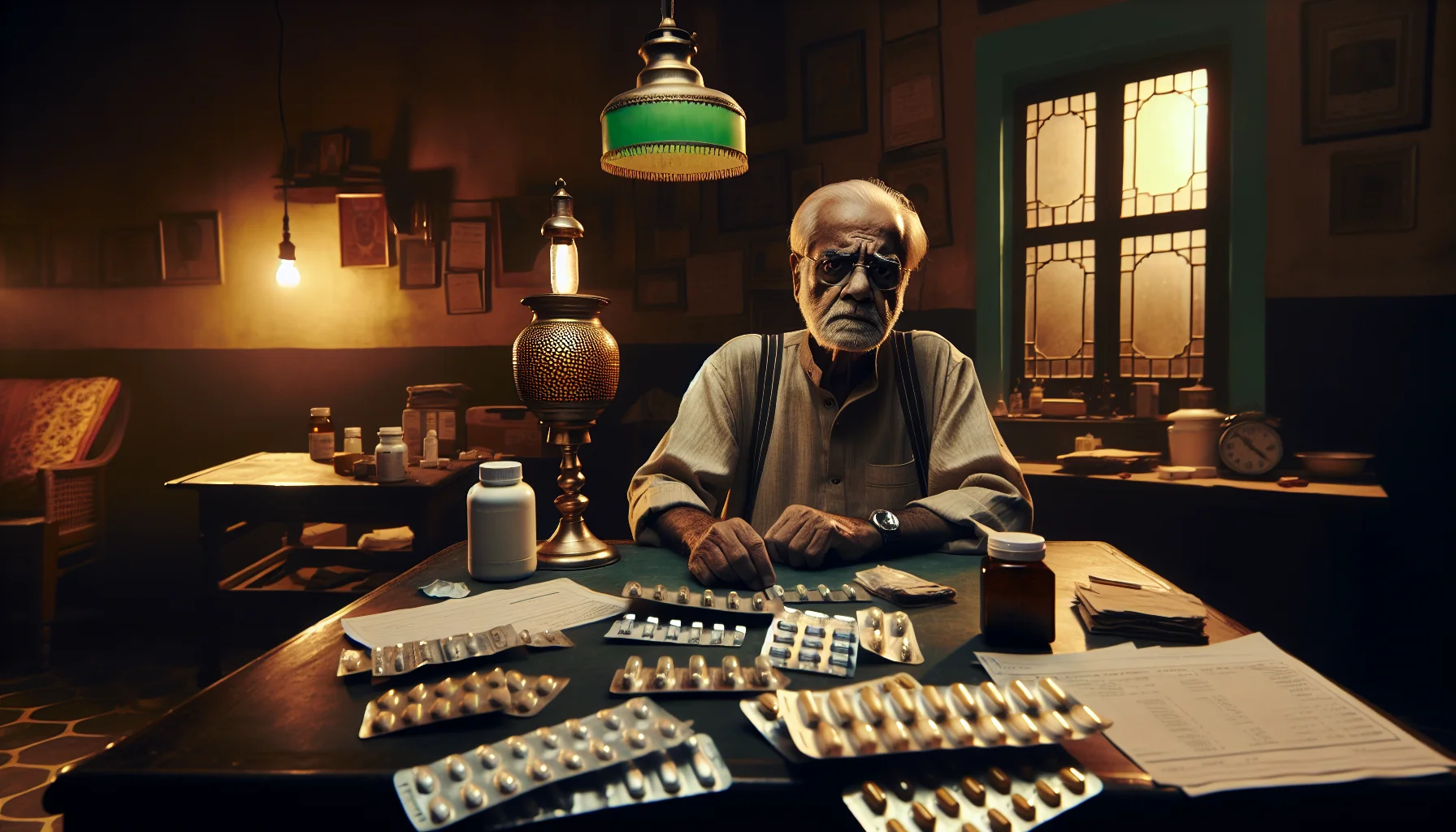
India's specialist-first healthcare system has no mechanism to coordinate what different doctors prescribe. For elderly Indians managing multiple chronic conditions, this creates a silent polypharmacy crisis that families rarely recognise until something goes wrong.
- 49% of elderly Indians are on polypharmacy (5+ medicines simultaneously); 31% are on hyperpolypharmacy (10+ medicines)
- Most of these medicines are prescribed by different specialists who have never seen each other's prescriptions
- 10% of elderly ambulatory patients in India experience adverse drug reactions — most linked to polypharmacy
- 96.3% of patients in one study filled prescriptions at more than one pharmacy — no single chemist had the full picture
- 28% of all prescriptions for elderly Indians contain potentially inappropriate medicines
Baba turned 68 last October. He has had hypertension for eight years — the cardiologist at Sawai Man Singh Hospital in Jaipur has been managing it with Amlodipine. Then his knee started hurting. The orthopaedist at Santokba Durlabhji added a painkiller and a muscle relaxant. Two years ago, the annual checkup showed blood sugar creeping up. The endocrinologist added Metformin. Then his creatinine came back slightly high on one test — just one — and the family, understandably worried, got him a nephrology appointment. The nephrologist prescribed an ACE inhibitor for kidney protection.
Baba's general physician, who has been seeing him since he was forty, still prescribes the usual: a multivitamin, an antacid for the stomach trouble that started after the painkillers, and a vitamin D supplement. He writes these at every visit without checking what the specialists are prescribing, because nobody brings all the slips to his clinic.
Count the strips. Seven medicines. Five doctors. Not one of them has a complete list of what the others are giving him. Baba himself cannot name all of them. The family keeps the strips in a Tupperware container on top of the fridge, sorted loosely by size.
This is not unusual. This is Tuesday in India.
How India's Healthcare System Creates the Polypharmacy Trap
In most high-income countries, a GP acts as a gatekeeper and coordinator. Before you see a cardiologist, your GP knows your full medicine list. When the cardiologist prescribes something new, the GP reconciles it against everything else you are taking. The system is far from perfect, but there is at least a structural attempt at coordination.
India has no such system at scale. Patients self-refer directly to specialists. If your knee hurts, you go to an orthopaedist. If your sugar is high, you go to an endocrinologist. If your chest feels tight, you go to a cardiologist. Each specialist is skilled at treating the organ in front of them. None of them — by training, by incentive, or by time — is responsible for asking what the other four doctors are currently prescribing.
The chemist adds the final layer of fragmentation. Most families do not fill all their medicines at the same shop. One prescription goes to the chemist near the hospital. Another goes to the local chemist near the house. A third is from an online pharmacy. The result: no single chemist has visibility over the complete medicine list. One study found that 96.3% of elderly patients obtained their medicines from more than one pharmacy. Nobody is looking at the whole picture because nobody can.
Dependence on more physicians leads to polypharmacy and drug-drug interactions, as geriatric patients often have more than one disease and may consult different specialists for each condition. The patient, carrying prescriptions from multiple providers, remains the only integrating factor in their own care — and they are often the least equipped to perform this function.
— PMC Review: Issues and Challenges of Polypharmacy in the Elderly, Indian Literature (2021)
The polypharmacy problem in India is not caused by reckless prescribing. It is caused by a structural absence of coordination between specialists — and the fact that in most cases, the only person with access to all the prescriptions is the patient or a family member who cannot read them.
The Numbers Are Worse Than You Think
Polypharmacy is defined as taking five or more medicines simultaneously. Hyperpolypharmacy — ten or more — is the more severe category. Both are far more common in elderly Indians than most families realise, and neither is unusual enough to trigger alarm on its own.
A systematic review and meta-analysis published in PMC, drawing on data from across India, found that almost half of all elderly patients are on polypharmacy — and nearly one in three is on hyperpolypharmacy. These are not patients in extreme clinical situations. These are people like Baba: aging adults with two or three chronic conditions, each managed by a different specialist, each adding their own prescription to the pile.
The potentially inappropriate medication figure — 28% — refers to medicines that, according to established geriatric prescribing criteria like the Beers list, are known to cause more harm than benefit in elderly patients. Sedating antihistamines, certain antacids, some painkillers: these appear on inappropriate prescribing lists precisely because elderly patients metabolise drugs differently, because kidneys and livers work less efficiently, and because the interactions multiply as the medicine count rises.
| Metric | Prevalence in elderly Indians | What it means in practice |
|---|---|---|
| Polypharmacy (5+ medicines) | 49% | Nearly 1 in 2 elderly patients; higher in urban areas with specialist access |
| Hyperpolypharmacy (10+ medicines) | 31% | Almost 1 in 3 — a medicine for each chronic condition, each symptom, each specialist |
| Potentially inappropriate medicines | 28% | More than 1 in 4 prescriptions contain something that may cause more harm than good in elderly patients |
| Adverse drug reactions | 10% of ambulatory patients | 1 in 10 elderly patients taking medicines experiences an ADR — most preventable with coordination |
| Drug-drug interactions | 8% of prescriptions | 1 in 12 prescriptions has a measurable interaction with another medicine the patient is already taking |
When Medicines Fight Each Other
Drug-drug interactions are not rare, exotic events that happen to unlucky patients. They are a predictable mathematical consequence of polypharmacy: the more medicines you add, the more potential interaction pairs you create. With five medicines, there are ten possible interaction pairs. With ten medicines, there are forty-five.
In the Indian context, some combinations are particularly common because they follow directly from the most common combinations of chronic conditions. Hypertension plus diabetes plus arthritis — three of India's top chronic disease burdens — is a recipe for exactly the kind of multi-drug overlap that creates interaction risk.
- NSAID (painkiller for knee) + ACE inhibitor (for BP or kidney protection): NSAIDs can reduce the effectiveness of ACE inhibitors and increase kidney stress — a problem if the ACE inhibitor was prescribed specifically because the kidneys are already under pressure
- Two antacids from two different doctors: One prescribed because the cardiologist's aspirin causes stomach irritation; another prescribed by the GP because the orthopaedist's painkiller causes the same. The patient ends up on double antacid dosage with neither doctor aware of the duplication
- Sulfonylurea (diabetes drug) + certain BP medicines: Some beta-blockers mask the symptoms of hypoglycaemia — the shaking, sweating, and racing heart that warn a diabetic patient their sugar is dropping too low. If both are prescribed by different doctors, neither may think to flag this
- Two BP medicines from two doctors: A cardiologist prescribes Amlodipine; a nephrologist adds an ACE inhibitor for kidney protection. Both are legitimate decisions individually. Together, they may cause blood pressure to drop too far, resulting in dizziness, falls, or worse
My father-in-law was on Amlodipine from his cardiologist and Enalapril from the nephrologist. For weeks, he was dizzy every time he stood up. We thought it was age. Finally, a young doctor at Apollo Jaipur looked at the full list and said these two together were pushing his BP too low. The nephrology and cardiology departments are in the same hospital. They had never compared notes.
— IT professional, Jaipur (shared in a chronic illness family support group, anonymised)
The tragedy is not that these doctors were careless. It is that they were each doing exactly the right thing within their specialty, without the information they would have needed to see the interaction risk. The information existed — spread across three prescription slips in a Tupperware box at home — but nobody had assembled it into one place where a doctor could read it in thirty seconds.
Drug-drug interactions in India's elderly are not failures of medical skill — they are failures of information flow. Each doctor is competent. What is missing is a single, shared, complete medicine list that any doctor can glance at before writing a new prescription.
The Shoebox: How Indian Families Actually Manage
Every Indian family with an elderly parent who has multiple conditions knows about the shoebox. It goes by different names in different homes — a steel dabba, a Tupperware container, a plastic carry bag from Apollo, an actual shoebox — but it contains the same things everywhere: a tangle of medicine strips, some from 2023, some from 2025, and a collection of prescription slips in varying states of legibility, folded and refolded along the same creases until the paper starts to tear.
This is India's de facto medical record system for the elderly. Not a shared EHR. Not a care coordination app. A box that lives on top of the fridge or in the side-table drawer, that the family digs through every time there is a new doctor visit, trying to answer the question: "What is he currently taking?"
The WhatsApp prescription photo is the shoebox's digital evolution. Someone photographs all the prescription slips and forwards them to a relative who is a doctor, asking "Is any of this a problem?" The relative, eating dinner in another city, squints at three low-resolution images of handwritten prescriptions and sends back: "Looks okay but hard to read — go to a doctor." Nobody has the complete picture. Nobody ever does.
| What families do to manage multiple prescriptions | What information is missing | When it fails |
|---|---|---|
| Keep all strips in one box or container | Doses, timing, which doctor prescribed which, whether still current | At an ER when the doctor needs the full list immediately |
| WhatsApp prescription photos to a relative doctor | Image quality, handwriting, context — impossible to read reliably | When the relative cannot decipher the handwriting or misses an interaction |
| Patient carries all slips to each new doctor | Old slips may be outdated; patient may not have all of them | When patient forgets to bring the stack, or brings only the most recent one |
| Family member memorises the medicine names | Generic vs brand confusion; doses not memorised; new additions forgotten | Under stress — exactly when accuracy matters most |
| Nothing — "the doctor will ask what he needs to know" | Everything the doctor does not know to ask | Always — doctors cannot ask about what they do not know exists |
What Your Chemist Cannot Know — And Why That Matters
The neighbourhood chemist occupies a unique and under-appreciated position in Indian healthcare. He is often the most accessible medical touchpoint in the family's life — more accessible than the specialist, faster than a hospital OPD, available at 9pm when the doctor's clinic is closed. Elderly patients and their families consult him constantly: "Which one is the BP medicine? Can he take both at the same time? Is this the right dose?"
The chemist does his best. But he is working with a fundamental information problem. A study found that 96.3% of patients obtained their medicines from more than one pharmacy. This means the chemist filling the cardiologist's prescription has no idea that the endocrinologist's prescription was filled at the chemist near the hospital last week. He cannot check for interactions because he does not know what the patient is already taking.
This is not a criticism of chemists. They are not equipped — structurally, informationally, or by regulation — to perform medication reconciliation. That is a clinical function. But in India, where clinical coordination between specialists is absent, and where there is no shared electronic health record connecting a GP to a specialist to a pharmacist, the chemist is often the last chance to catch an interaction before the patient takes it home.
He brought the prescription from the orthopaedic doctor, and I filled it — Diclofenac and Pantoprazole. I had no way to know he was also on a blood thinner from the cardiologist. When you have a hundred patients in a day and each one is coming from a different doctor, how will you know? The slip doesn't say "also taking X." Nothing says that.
— Chemist, Jaipur Civil Lines (shared context, paraphrased to protect privacy)
The failure is not with the chemist. It is with the absence of a consolidated medicine record that any prescriber or dispenser can access before adding something new to the pile.
The One List That Changes Everything
The solution to the polypharmacy coordination problem is not a more cautious cardiologist, or a better-informed orthopaedist, or a more vigilant chemist. Each of these people is already doing their job. The solution is giving every one of them the same piece of information they currently lack: a complete, current, accurate list of every medicine the patient is taking.
This sounds trivially simple. In practice, it has been nearly impossible to maintain — because the list lives in a box on top of the fridge, is written on paper from 2022, and is updated only when a family member happens to add the latest prescription slip to the pile.
MedLogsRx was built specifically for the Indian context of fragmented, multi-doctor prescribing. The prescription scanner handles the handwriting that defeats most OCR tools — the Jaipur cardiologist's cursive, the Apollo endocrinologist's abbreviated Latin, the GP's barely-legible shorthand. Each scan adds to a single, clean, digital medicine list.
That list is what you show every new doctor before they write another prescription. "Here is everything Baba is currently taking." In thirty seconds, the doctor can see seven medicines from five doctors. She can spot the NSAID-ACE inhibitor overlap. She can notice the duplicate antacid. She can choose not to add an eighth medicine that would interact with the second.
The dose alert feature matters for polypharmacy patients specifically. When you are managing seven medicines across multiple schedules — some twice a day, some once, some with food, some without — the cognitive load of tracking adherence without a system is enormous. MedLogsRx sends a reminder for each medicine, tracks which have been taken, and shows a 30-day adherence history. A caregiver in Bengaluru can see, at a glance, whether Baba took all seven of his medicines this morning.
Low-stock tracking is particularly important when you have multiple prescriptions from multiple doctors, often filled on different dates with different quantities. Running out of one medicine in a seven-medicine regimen is easy to miss — until the cardiologist's medicine runs out on a Thursday and nobody notices until Monday.
My husband has heart disease, diabetes, and arthritis. We used to go to each new doctor and just hope for the best. After I scanned all his prescriptions into MedLogsRx, I showed the list to his new nephrologist. She immediately said, "This painkiller is not good for kidneys — let's change it." That would never have happened without the list. The old nephrologist we used to see never knew he was on it.
— Primary caregiver, Jaipur, managing husband's four-specialist treatment plan (MedLogsRx user)
India's healthcare system is not going to grow a GP-coordination layer overnight. The specialist-first model is entrenched, under-resourced, and used by hundreds of millions of people who have no other option. What can change today is the information flow — whether the cardiologist knows what the orthopaedist prescribed, whether the chemist sees what the endocrinologist added last month, whether the family in Bengaluru knows which of Baba's seven strips is running low.
The shoebox on top of the fridge is not incompetence. It is a family trying their hardest with a system that gives them no better tool. MedLogsRx is the better tool — a digital medicine list that can be shown to any doctor, anywhere, in thirty seconds.
Sources
- PMC — Prevalence of Polypharmacy, Hyperpolypharmacy and Potentially Inappropriate Medication Use in Older Adults in India: Systematic Review
- PMC — Polypharmacy and Self-Medication Among Older Adults in Indian Urban Communities
- PMC — Issues and Challenges of Polypharmacy in the Elderly: A Review of Contemporary Indian Literature
- PMC — Adverse Drug Reactions and Their Risk Factors Among Indian Ambulatory Elderly Patients
- PMC — Prevalence of Polypharmacy and Drug Interactions in Geriatric Patients: Cross-Sectional Study from India
- Nature Scientific Reports — Polypharmacy and Self-Medication Among Older Adults in Indian Urban Communities