Prescription Management · April 12, 2026 · 9 min read
The Prescription Nobody Could Read
Every year, millions of Indian families leave the clinic clutching a slip of paper that nobody — not the chemist, not the patient — can actually read. Here is why it matters, and why the consequences are far more serious than we admit.
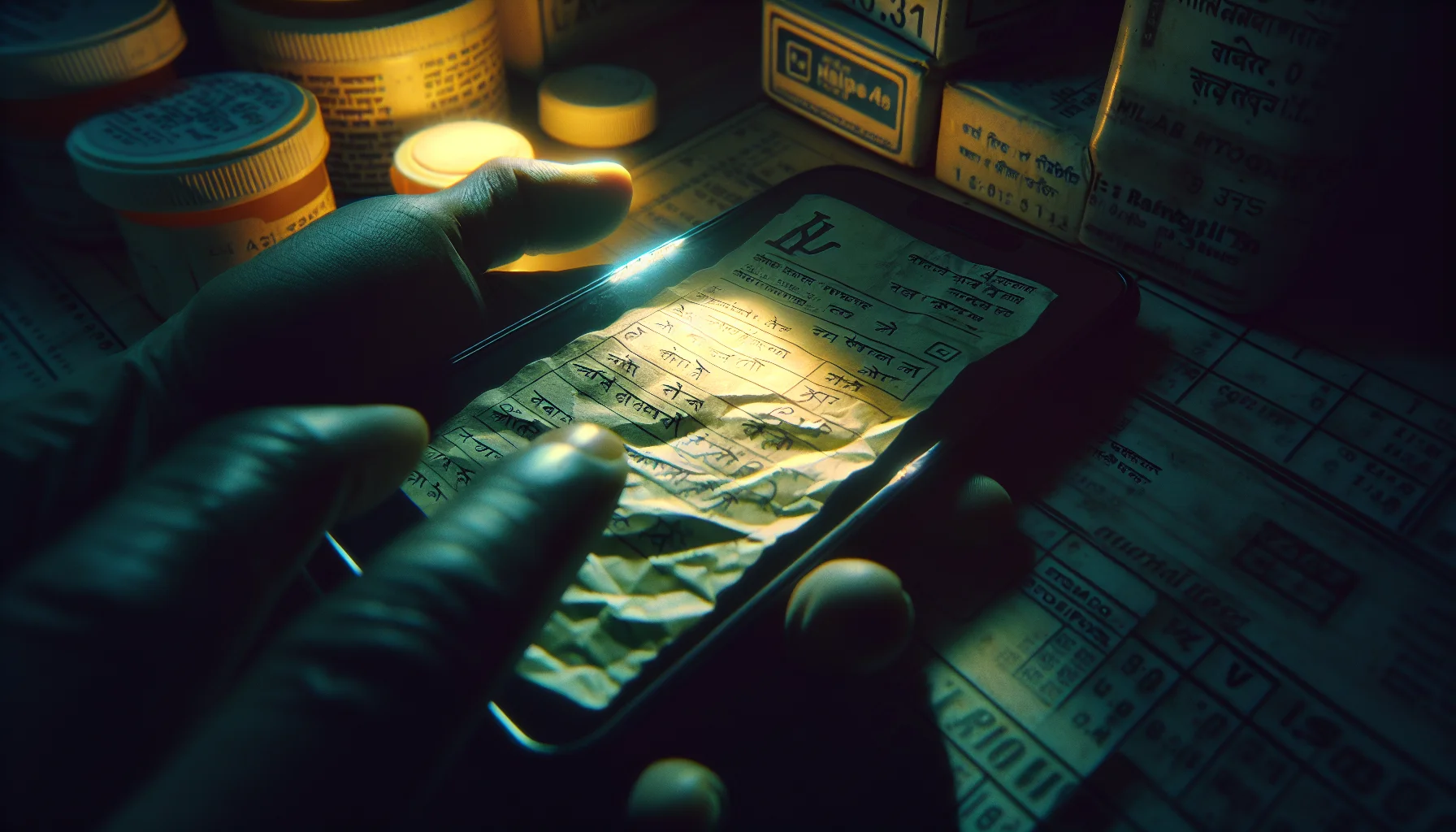
Illegible prescriptions in India are not just an inconvenience — they are a documented patient safety crisis that courts have stepped in to address. Here is what you need to know:
- Indian government OPD doctors see 70–100 patients per day, making careful handwriting practically impossible
- The Medical Council of India estimates approximately 7,000 deaths per year are attributable to prescription misreading — and India has no centralized tracking to confirm the real number is not higher
- 24.41% of prescriptions studied in Indian hospitals had handwriting classified as poor or illegible
- The Punjab & Haryana High Court ruled in 2023 that a legible prescription is a "fundamental right" of every patient
- Most Indian families rely on the chemist to decode what the doctor wrote — a chain that snaps the moment you are anywhere other than your regular shop
My nani has been going to the same cardiologist in Lajpat Nagar for eleven years. He is a good doctor. She trusts him completely. After every visit, she comes home clutching a small slip of paper — the kind torn from a pharmaceutical-company notepad, sometimes bearing the logo of a drug she has never heard of. Three or four medicine names, a dosage, maybe "after food" scrawled at the side. That is it.
The problem is that no one in our family can read it.
Not the chemist on the main road, who squints at it and usually guesses. Not my mother, who holds a commerce degree. Not my nani herself, who just nods and says "doctor ne likha hai, sahi hi hoga." The doctor wrote it, so it must be right. This trust is beautiful. It is also, in ways most families do not like to think about, quietly dangerous.
A System Built on the Chemist Knowing the Doctor
India has roughly 1.4 million registered allopathic doctors for over 1.4 billion people. Most are overworked in ways that are difficult to overstate. In a typical OPD at a government hospital — Delhi, Lucknow, Patna, Bhopal — a single doctor sees between 70 and 100 patients in a single session. At that pace, the prescription becomes shorthand. A note passed to the chemist, not a document intended for the patient.
The system works — barely — when every link in the chain holds. When your regular chemist, who has spent years decoding this particular doctor's scrawl, is behind the counter. When you are buying medicines near home and not traveling. When the medicine name on the slip does not happen to look too much like a different, potentially dangerous drug.
A Journal of Clinical and Diagnostic Research study that audited hundreds of prescriptions from Indian hospitals found that nearly a quarter had handwriting so poor it could not be reliably read. That is one in four slips. India processes roughly 3 billion paper prescriptions in urban areas every year. Run the numbers: approximately 750 million prescriptions annually carry a meaningful risk of being misread.
The Anatomy of a Prescription Error
Errors from illegible prescriptions do not look like dramatic Hollywood emergencies. They usually look like small, quiet mistakes whose consequences emerge days later, far from the chemist's counter.
A pregnant woman in Hyderabad received the wrong medication because the pharmacist misread the handwritten prescription. The drug dispensed was contraindicated during pregnancy. The result was a miscarriage — entirely preventable, entirely the product of handwriting that looked like one drug name but meant another entirely.
— Documented in Indian medical malpractice case records
A patient was administered 40 units of insulin instead of 4. The doctor had written "4U" — the nurse read the "U" as a zero. This single-character ambiguity caused a tenfold overdose. The Institute for Safe Medication Practices has flagged "U" as a dangerous abbreviation for decades. It continues to appear in Indian handwritten prescriptions every day.
— Institute for Safe Medication Practices (ISMP) case documentation
These are not outliers. The Medical Council of India's own estimates attribute approximately 7,000 deaths per year to prescription misreading — and India has no centralized adverse-event reporting system to verify whether the true number is lower or, more likely, higher. In a country of 1.4 billion people with paper-dominant prescribing, we are counting deaths by inference, not by record.
The problem is not isolated to dramatic overdoses. Subtler errors are more common: a blood pressure drug dispensed instead of a diabetes drug. An antibiotic given at double strength because the dose looked like it had an extra zero. A twice-daily medicine taken once because the chemist could not read the frequency and guessed. These produce consequences that are diffuse, delayed, and almost never traced back to the prescription that caused them.
The Chemist's Impossible Choice
When a chemist receives an illegible prescription, they face a decision no healthcare worker should have to make: guess, or refuse to dispense.
In theory, the responsible action is to call the prescribing doctor and verify. In practice, this almost never happens. The doctor is mid-clinic and unreachable by phone. The patient is standing at the counter, unwell, waiting. There are fifteen people in the queue behind them. Calling the doctor and waiting for a callback could take hours — hours the patient cannot afford if the medicine is urgent.
I have been behind this counter for nineteen years. I estimate I have guessed at least forty thousand prescriptions in my career. I use context clues — the patient's age, the probable diagnosis, which drugs are commonly prescribed for those symptoms, the particular doctor's writing that I have learned to read over time. I am right most of the time. But "most of the time" is not an acceptable accuracy rate when the other option is someone's health.
— Senior chemist, Bengaluru (anonymized, from a patient safety forum)
Experienced chemists develop near-encyclopedic knowledge of specific doctors' handwriting. A shop near a particular hospital sees hundreds of prescriptions from the same handful of doctors and, over years, learns their personal script. The system works — until the patient travels to another city. Or the regular chemist goes on leave. Or a new doctor joins the clinic and no one in the shop has seen their handwriting before.
The problem compounds with look-alike brand names. India's pharmaceutical market has tens of thousands of registered brands, many sharing similar-sounding names. When the chemist is guessing under time pressure, these similarities become landmines — especially for elderly patients who may not know what medicine they are supposed to be getting.
What Most Families Do Instead
Ask any family managing a parent's chronic medicines and you will hear the same improvised workarounds, described in the same exhausted tone.
You photograph the prescription. The photo goes into a camera roll of ten thousand images where it will never be found again. You type the medicine names into Google, squinting, unsure whether that is a "p" or an "r" in the third letter. You WhatsApp the doctor's number and wait, usually to speak with a receptionist who says "come in again." You call a cousin who is a nurse. You carry the slip back to the chemist the next day and ask them to read it aloud.
The camera roll has become India's unofficial prescription archive. Millions of families photograph their prescription slips and store them in a gallery mixed with vacation photos, screenshots, and food pictures. This is not a system. It is chaos with a timestamp.
My father came back from the cardiologist with three medicines written in handwriting nobody in our house could make out. We spent two hours on Google trying to identify the second one. We eventually got it right. But I kept thinking — what if we had not? What if we had been in a hurry, or the chemist had just dispensed the closest-looking name without checking?
— Family caregiver, New Delhi (shared in a caregiving community forum)
For joint families — still the norm across much of India — the problem multiplies across generations. A household with grandparents, parents, and children might be managing prescriptions from five or six different doctors across two cities. Nana's cardiologist in Chennai. Dadi's endocrinologist in Jaipur. The child's pediatrician nearby. Each slip is a separate gamble, managed by a different family member, stored in a different drawer.
| Workaround | What families do | Where it fails |
|---|---|---|
| Photograph prescription | Camera app at clinic | Lost in gallery of thousands of images |
| WhatsApp group | "Medical Records" chat with photos | Unsearchable, cluttered, no structure |
| Rely on regular chemist | Same shop for years | Fails when traveling, chemist on leave, or new doctor |
| Call cousin/nurse | Ask a medical professional in family | Unavailable in emergencies, not always reliable |
| Carry slip to every visit | Keep physical paper | Gets lost, damaged, faded — especially through monsoons |
None of this should be the patient's job. But until India completes its transition to digital prescriptions — a transition the government's ABHA system has begun but not finished — these workarounds are all most families have.
What Courts Are Saying (And Why Enforcement Is Nearly Absent)
The Indian judiciary has taken a surprisingly firm stance on prescription legibility — stronger, in some respects, than the medical regulatory bodies themselves.
The Punjab and Haryana High Court ruled that "a legible prescription is a fundamental right" of every patient. The court directed the National Medical Commission to issue comprehensive legibility guidelines and recommended that prescriptions be written in capital letters — or, preferably, typed or digitally generated. A two-year timeline was set for digitisation across the state.
The National Medical Commission has issued guidelines directing doctors to write legibly, use generic names, and avoid dangerous abbreviations like "U" for units and "OD" where context is ambiguous. These guidelines exist on government letterhead. Their enforcement exists almost nowhere.
The right to health encompasses the right to receive accurate, legible medical instructions. A prescription that cannot be read is a prescription that cannot be followed. It violates the patient's right to proper medical care.
— Punjab and Haryana High Court, 2023
The gap between regulatory aspiration and ground-level reality in India is not caused by indifference. It is caused by the same structural forces that created the handwriting problem in the first place: doctors seeing too many patients with too few resources, in a healthcare system that was never designed to handle 1.4 billion people's medical records simultaneously. Courts can declare rights. They cannot add six hours to a doctor's day.
Closing the Gap — What You Can Do Before the System Catches Up
The systemic solutions — universal e-prescribing mandates, ABHA integration across every private clinic, regulatory enforcement with teeth — will take years, possibly a decade, to reach every patient in India. But the problem at the chemist counter exists today. And there is a practical solution available today.
When we built MedLogsRx, this was the specific moment we kept returning to during design. Not an abstract "medication adherence" dashboard. Not a generic health app. That particular scene: standing at the chemist counter, phone flashlight on, trying to decode a prescription written in three rushed minutes after an eleven-year relationship with a cardiologist.
The AI prescription scanner in MedLogsRx uses vision AI to process any paper prescription — blurry photo, crumpled paper, poor lighting. It does not simply do character recognition. It understands pharmaceutical context: it knows that a certain scrawl in a cardiac patient's prescription is more likely to be "Atorvastatin" than "Azithromycin." It extracts medicine names, dosages, frequency, and duration. It creates reminders automatically. It logs everything against the right family member's profile.
You do not need to wait for India's healthcare infrastructure to catch up. The solution to illegible prescriptions does not require your doctor to change their handwriting, your chemist to get better at guessing, or the government to mandate e-prescribing. It requires a camera and thirty seconds.
My nani does not use apps herself. But my mother does. Now, every time nani comes back from Lajpat Nagar, my mother scans the prescription before they have left the parking lot. The medicine names are logged. Reminders are set for the correct doses at the correct times. And the next time nani visits a chemist in Chandigarh — or is admitted to a hospital that has never seen her records — we already know exactly what to ask for, spelled correctly, at the right dose.
That shift — from guessing to knowing — is what MedLogsRx was built to do. Not to replace the doctor. Not to replace the chemist. Just to close the gap between what is written on that slip and what actually happens in the medicine cabinet at home.
If you have a family member on regular medicines and you are still deciphering prescriptions by phone flashlight, this is what the app is for.
Sources
- Punjab & Haryana HC — Legible Prescription is a Fundamental Right (2023)
- CoverYou — Why Doctors' Handwriting is No Longer a Laughing Matter
- National Medical Journal of India — What's Wrong with Doctors' Handwriting?
- Institute for Safe Medication Practices — LASA Drug Name Errors
- PMC — Medication Adherence Among Elderly in Rural Karnataka
- Frontiers in Public Health — Interventions to Promote Medication Adherence in India